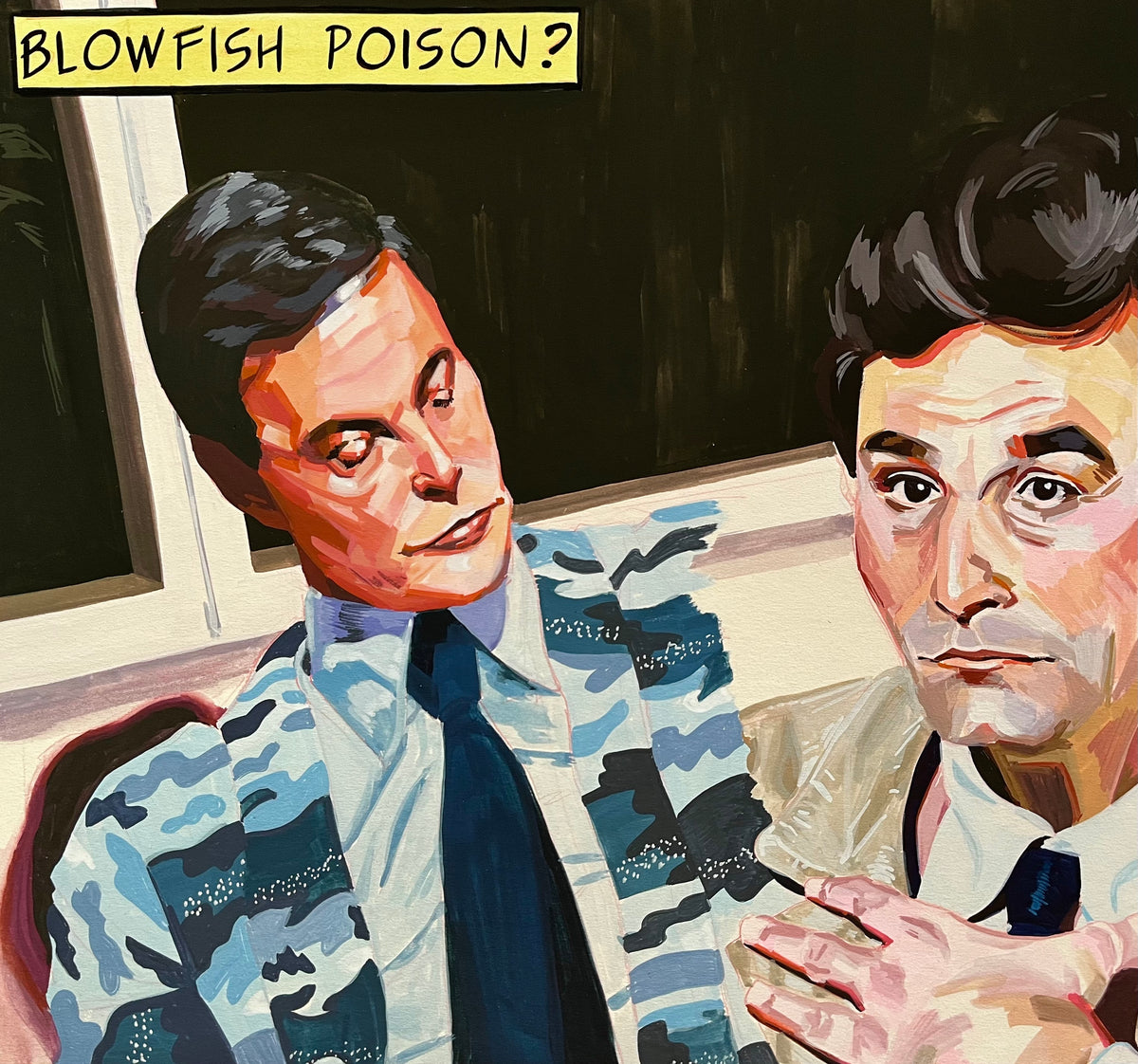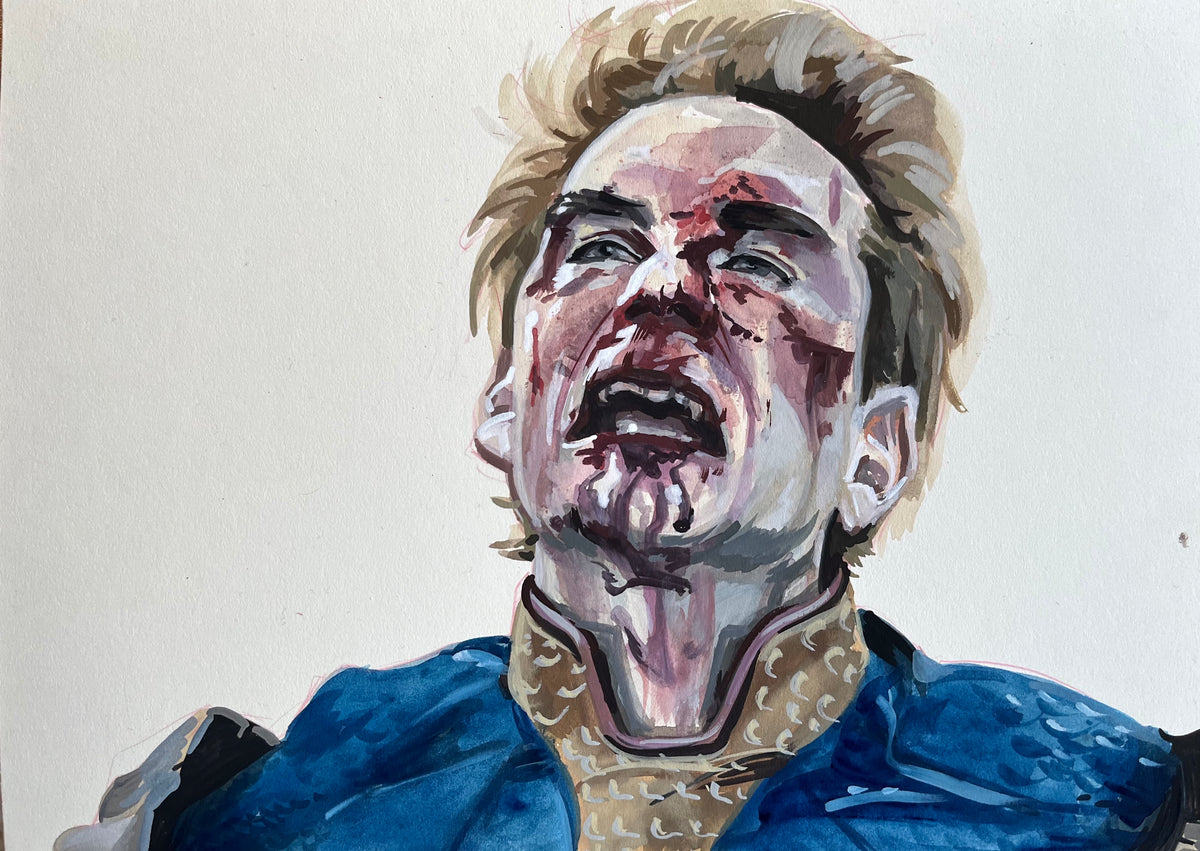


An advanced painting professor at the School of the Art Institute of Chicago once told Lily Formato that her sketchbook drawings were more interesting than her paintings.
She agreed with him. Then she spent the next several years figuring out what to do about it.
Bemused is the answer. It is a body of work made from a year of sketchbooks, and it is on view now at Formato Fine Arts.
Learning to look
Formato spent four years in Chicago doing two things at once: nightly stand-up and improv, and a BFA at the Art Institute. The combination turns out to be less strange than it sounds.
"The core tenets of improv are listening and yes-and-ing," she writes. "This trained me to observe my world more closely than I ever had before. Reading a room takes listening, mimicking, nodding, and drawing it."
That habit of watching is the through-line of the show. Formato describes being able to feel like a fly on the wall while remaining entirely present in the room. People tell her things. She writes them down and draws them.

The sketchbook as a research method
After graduating, the structure of school fell away and Formato had to build her own discipline. What she built was a drawing practice. Hundreds of pages in a year: observational drawing, collage, automatic mark-making, journaling. The sketchbook goes everywhere, without exception.

She works from life and from her own archive rather than from photographs, or at least not only from photographs, and she is specific about why. A phone camera flattens what it is trying to capture. The human eye handles depth better. Color and form are hard to find on a screen.
So the source material came from elsewhere: Alice Neel monographs, a book on the plants of the Appalachian Mountains, Goya and Matisse volumes gone fragile from years in her late grandmother's collection. Family photographs. Stills from films. She draws what interests her, and sometimes what does not.
The automatic drawings are their own category. Lines, dots, squares, connected without a plan, made on days when summoning a bird or a figure is beyond reach. "The decisions are easy and fixable," she writes. They fill many pages.
Ink, water, and pink gesso
The breakthrough was material. Formato prepared a batch of fresh canvases, grounded them in pink gesso, and gave herself permission to play.
She works into them with thin, sharp watercolor brushes and noir, walnut, and cobalt blue inks, transcribing images straight out of the sketchbook. The ink behaves like a ballpoint pen. The same frantic scribble that lived on paper now lives at scale.
The choice is partly about permission. "Oil paint feels too important, fragile and permanent," she writes. "The ink washes away with water, enriching the pink gesso, the walnut bleeding through."
What happens next is the interesting part. Drawings that meant one thing on the page start meaning something else on canvas. She flips between pages and connects one image to another, this to that, that to this. By the third or fourth time she has drawn a given image, confidence has accumulated, and each iteration earns more risk.

Oil comes later, and only when she starts wanting it. She loosens the canvas with Gamsol and stand oil, lays in washes to find the shadows, and works on several paintings at once, which she describes as a deliberate check on her tendency to overwork. It lets the paintings rest. It lets them talk to each other.
Maize

Formato's tortoiseshell cat appears throughout the show, as subject, as viewer, and as narrator.
"Her brown, black, and orange fur camouflages her into shadow in real life, but she will sunbathe on her window bed, fur illuminated, bright oranges and yellows reflecting off her body. A cat chameleon."
Formato is clear that she is not the chameleon in this arrangement. She makes herself known wherever she goes however she can become invisible.
Where it comes from
Formato grew up in Wytheville, in the most conspicuous house in town, which meant everyone knew where she lived. She had nightmares about being taken. She imagined she was an orphaned princess in a living house. Her best friend saw ghosts. She drew in her library books instead of reading them.
Her grandmother, a prolific artist, framed the child's drawings and hung them among her own work, alongside sad clowns and porcelain swaddled babies. That detail explains a great deal about this exhibition: an artist whose earliest experience of making was seeing her work taken seriously and hung on a wall.
"My being is fueled by my imaginative ancestors," she writes.
Not resolved, on purpose
The paintings move between registers without warning. The Rose Period series runs from self-portraiture into her relationship with Wytheville and then into family, addiction, and American religion. Sacrifice works through the process of understanding death. Homesick for Another World sits with anxiety. Night Painting is the feeling of being alone in fog.
And then there is a Teletubby, brought over by a friend and pressed into service as a still life.
The show does not reconcile these, and Formato does not pretend to have reconciled them. She is candid that some questions about the work remain open to her, including why these particular images belong together and where the religious and pop iconography is coming from. Her position is that it feels right, and that she is following it.

That is the most honest thing an artist can say about work made in the middle of a practice rather than at the end of one.
See it
Bemused debuted at Bloomfield Richwood Art Gallery in Richwood, West Virginia, opening June 11th. The collection is now on view and available at Formato Fine Arts.
Follow Lily on instagram @lilyformato
The ink work in particular does not photograph. The walnut bleeding through pink gesso is a thing you have to stand in front of.
Visit us Formato Fine Arts, 100 W Main Street, Wytheville, Virginia. Thursday through Saturday, 11 to 3. Sunday through Wednesday by appointment. Someone is usually here beyond posted hours, so it is always worth trying the door.